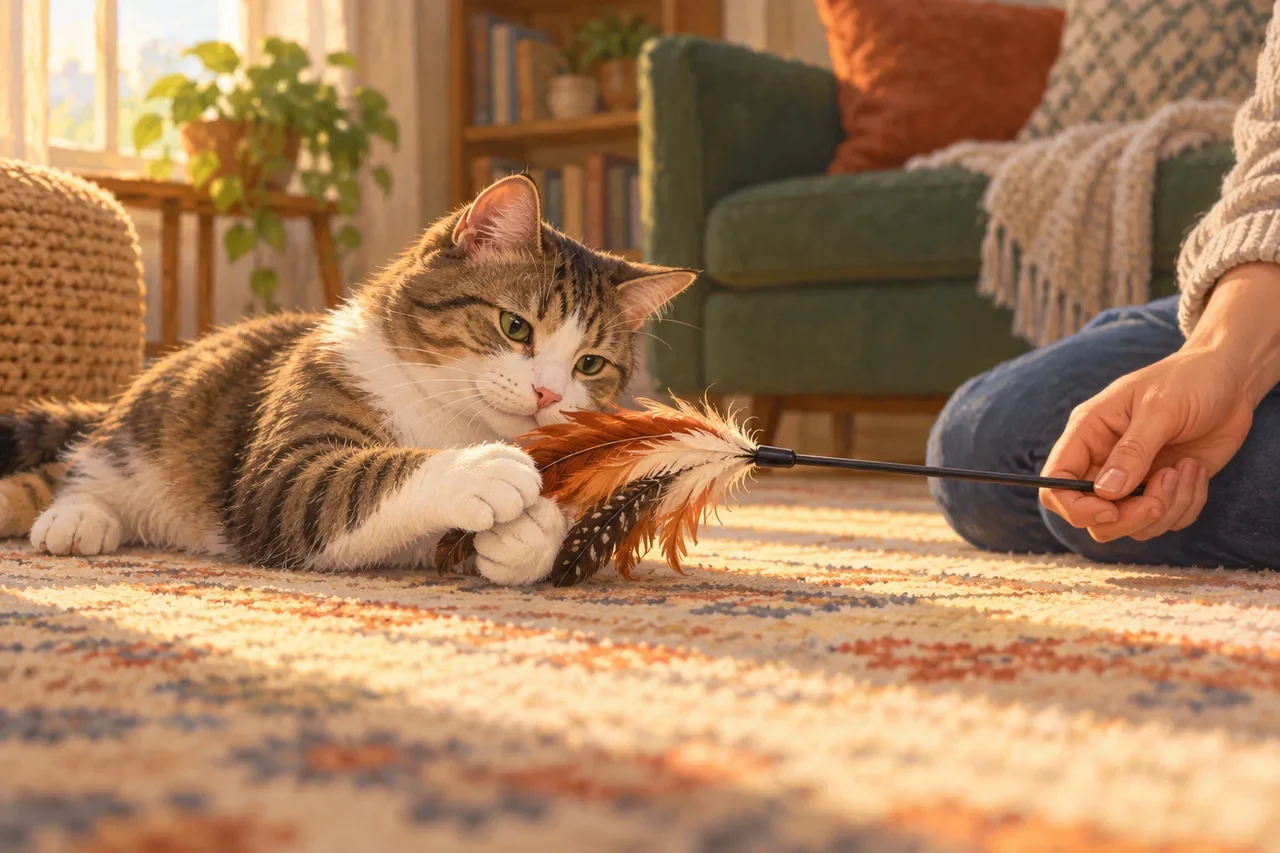
Illustrative editorial image generated with AI.
A satisfying play session gives a cat opportunities to stalk, chase and catch something. If the toy escapes every time and then disappears into a cupboard, the ending may be less rewarding than the chase. A calmer finish starts with how you move the toy throughout the game.
Make the toy behave like prey
Move a wand toy away from the cat, pause behind a safe obstacle and allow time for watching or stalking. Constantly waving it in the cat's face removes much of that sequence. Keep your hands out of the role of prey and choose movements that fit the cat's mobility.
Watching is not necessarily failure to play. Some cats spend longer observing before moving, while others prefer quick pounces. Let the cat choose whether to join; do not wake, corner or repeatedly touch a reluctant cat with the toy.
Build in catches before the final minute
Allow successful captures during the session, not only as a reward after sustained chasing. Let the cat hold or wrestle with an appropriate toy briefly instead of snatching it away immediately. Blue Cross's play guidance recommends short sessions and a chance to catch the toy at the end.
For the finish, reduce the toy's movement, offer one easy final capture and stop pulling. Once the cat releases it, put the interactive toy away. If a toy needs replacing, offer an appropriate alternative rather than starting a tugging contest with a cat holding a string in its mouth.
Prefer a toy the cat can actually catch
A physical toy makes the ending straightforward. Cats Protection's behaviour guide warns that laser games can create frustration because the target cannot be caught. Replacing a laser-led routine with a tangible toy is a practical way to provide capture, rather than assuming every cat enjoys endless chasing.
Match the effort to the individual
Several brief opportunities may suit a cat better than a marathon. Older cats or cats with health conditions may need slower, lower movements and veterinary advice about activity. Stop if the cat seems uncomfortable or distressed. Open-mouth breathing or persistent breathing difficulty should not be treated as a normal training target.
Make the ending safe and predictable
Inspect toys for loose parts and store strings, ribbons and wand toys out of reach after supervised play. If a small food reward fits the cat's routine, take it from the daily allowance rather than adding an extra meal. Cats Protection's feeding advice explains how treats affect that allowance. Then offer quiet space and let the cat settle without demanding more interaction.